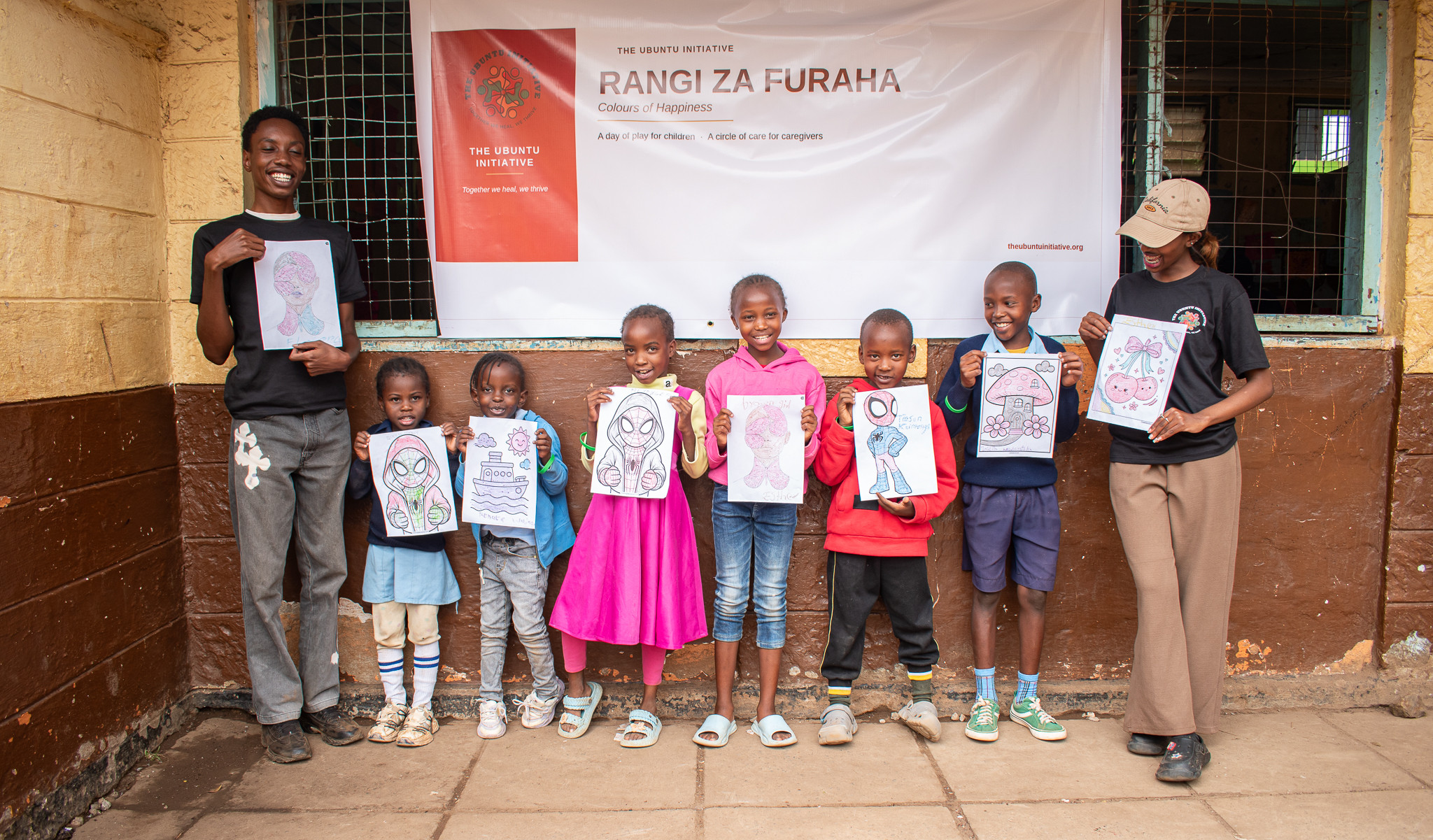
Play. Learn. Thrive.
We create safe, joyful spaces where children play, create, learn and develop through age-appropriate, play-based experiences.
- Early childhood development
- Play-based learning
- Creative expression
- Safe, nurturing spaces
The Ubuntu Initiative is a community-led organization in Nairobi working at the intersection of early childhood development and caregiver mental health. We support children aged 0-12 and the adults who care for them, together, in the same place, on the same day.
We create safe, joyful spaces where children play, create, learn and develop through age-appropriate, play-based experiences.
We support caregivers with psychologically informed spaces to connect, reflect, access practical support and strengthen their capacity to care.
When caregivers are supported, children are better positioned to thrive. When children thrive, families and communities become stronger. These are not two programmes. They are one model, and this is how a single day of it runs.
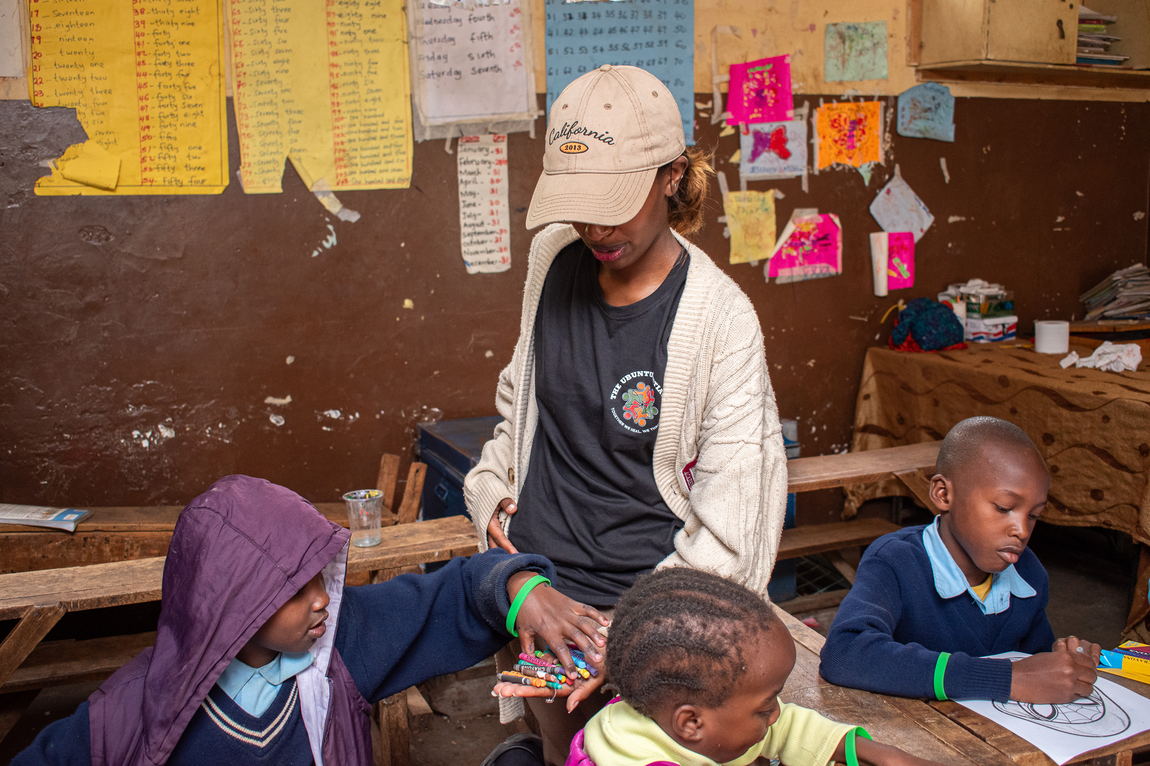
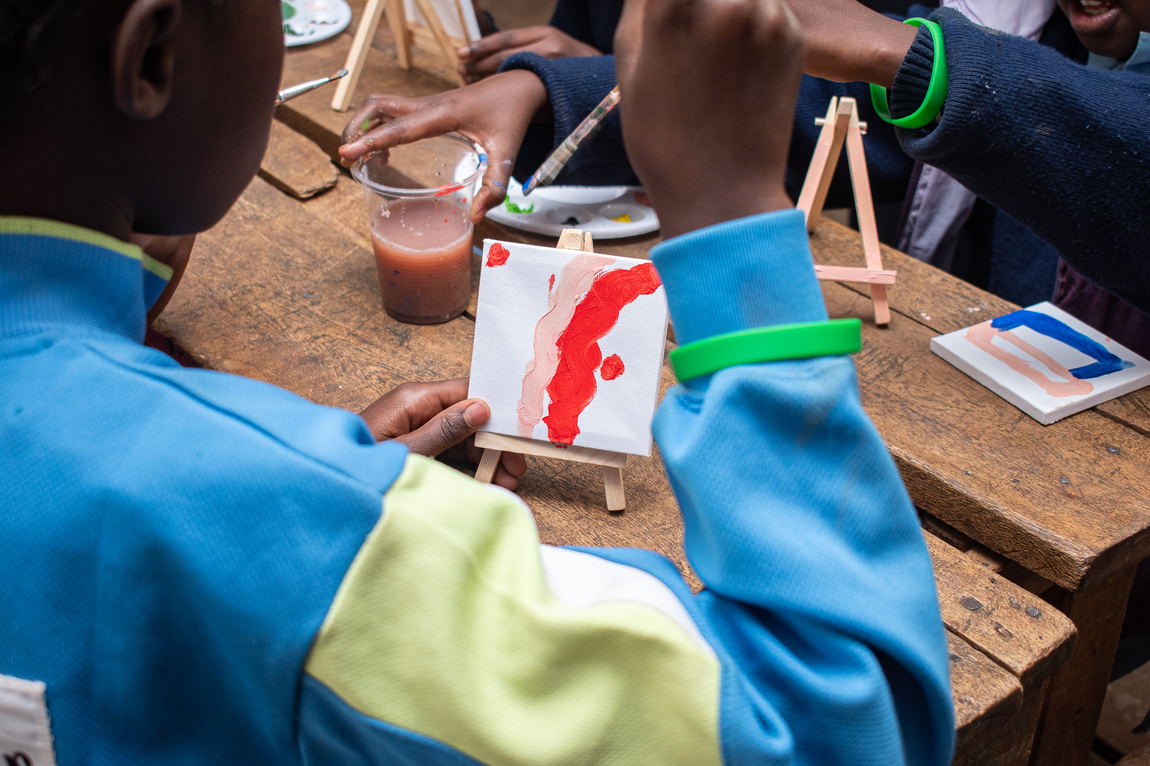
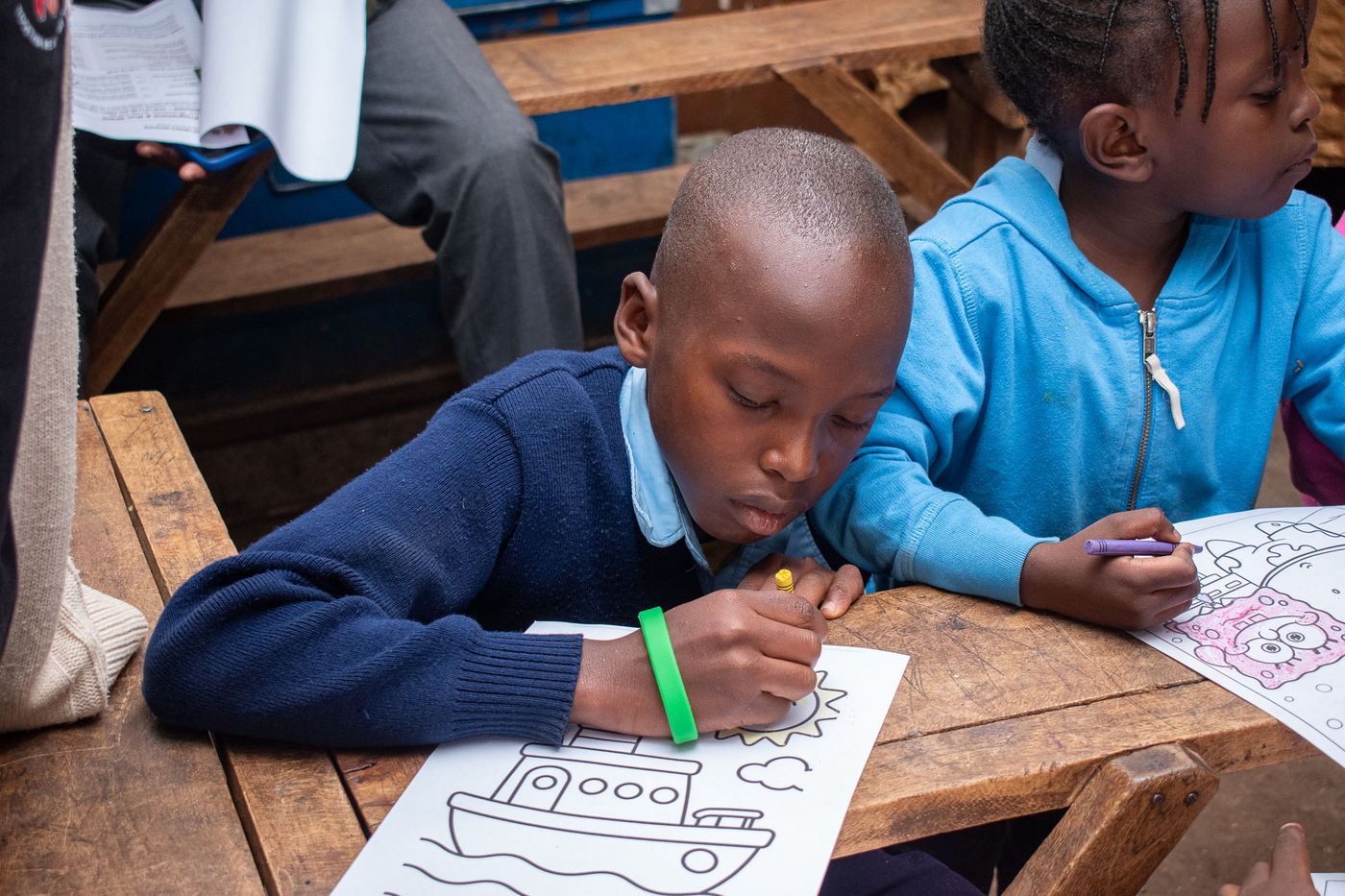
Children and caregivers sign in as households. Every child receives a colour-coded wristband: green where a caregiver has consented to photography, red where they have not, so consent is visible to every volunteer, at a glance, all day.
The day opens in front of everyone. At our first flagship day the Office of the Chief and the Sub-County Children’s Office each sent a representative as guest of honour.
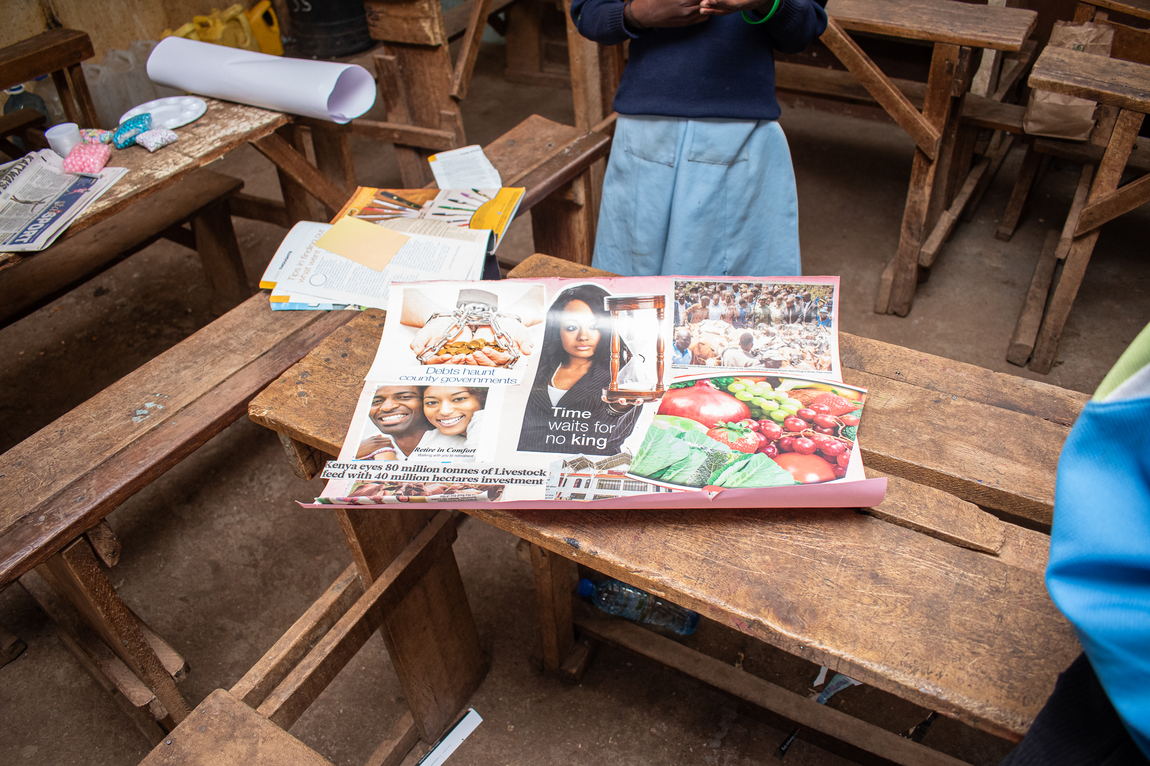
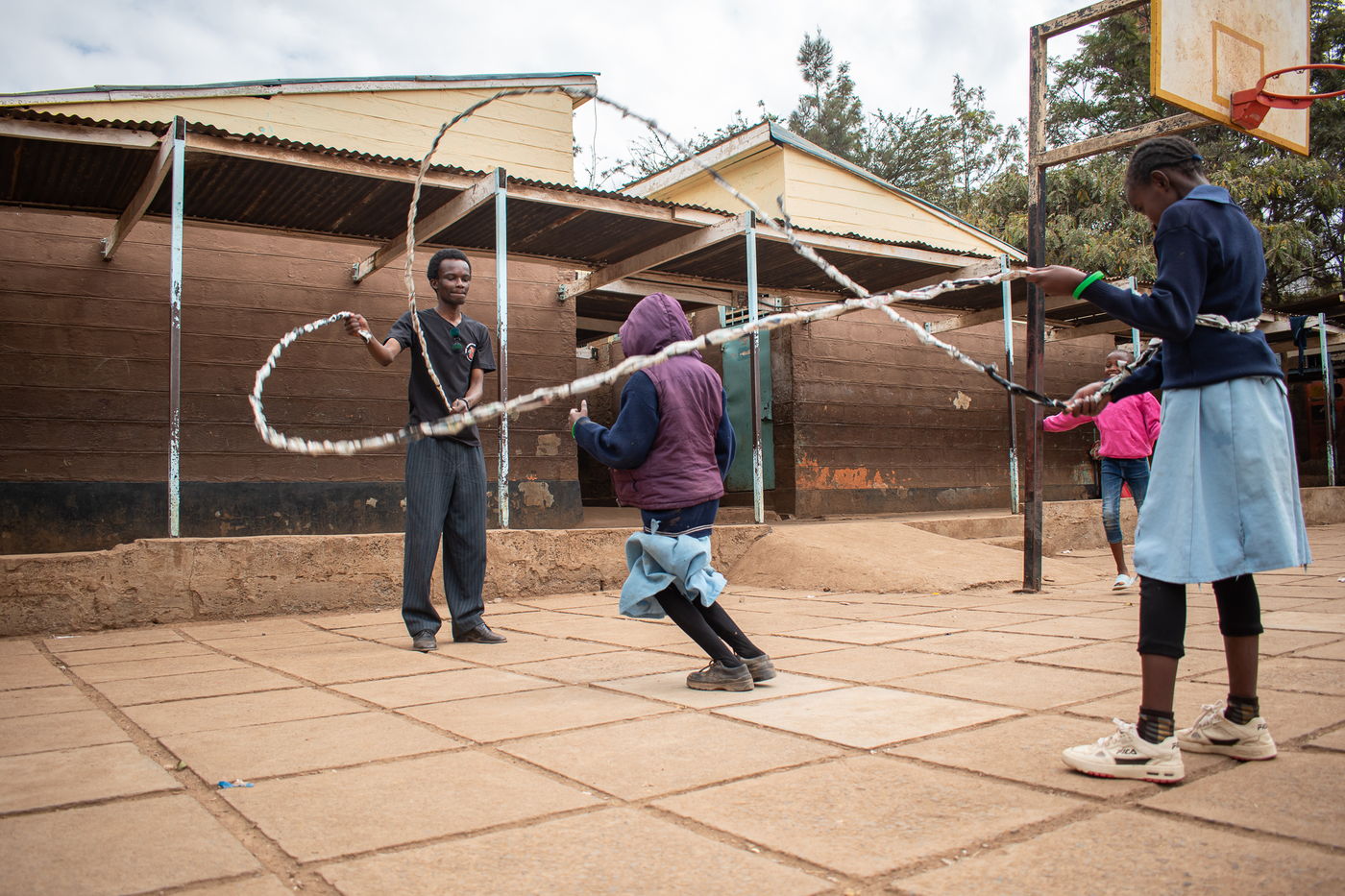
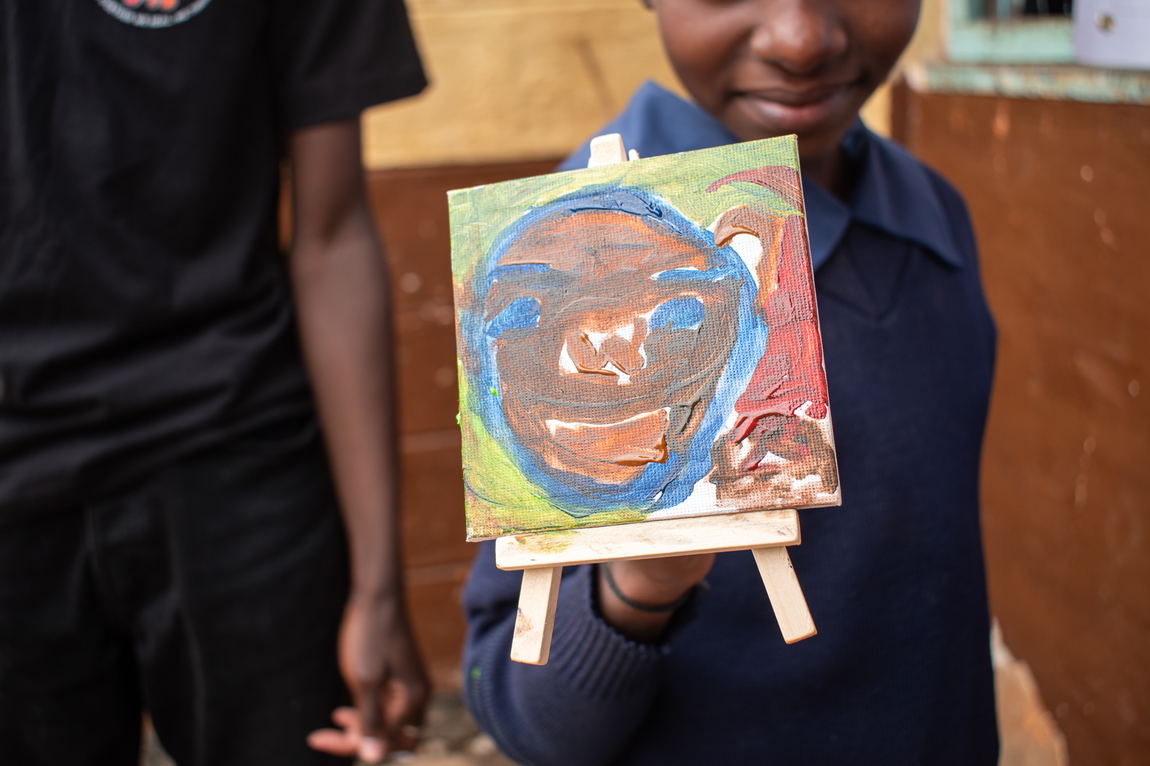
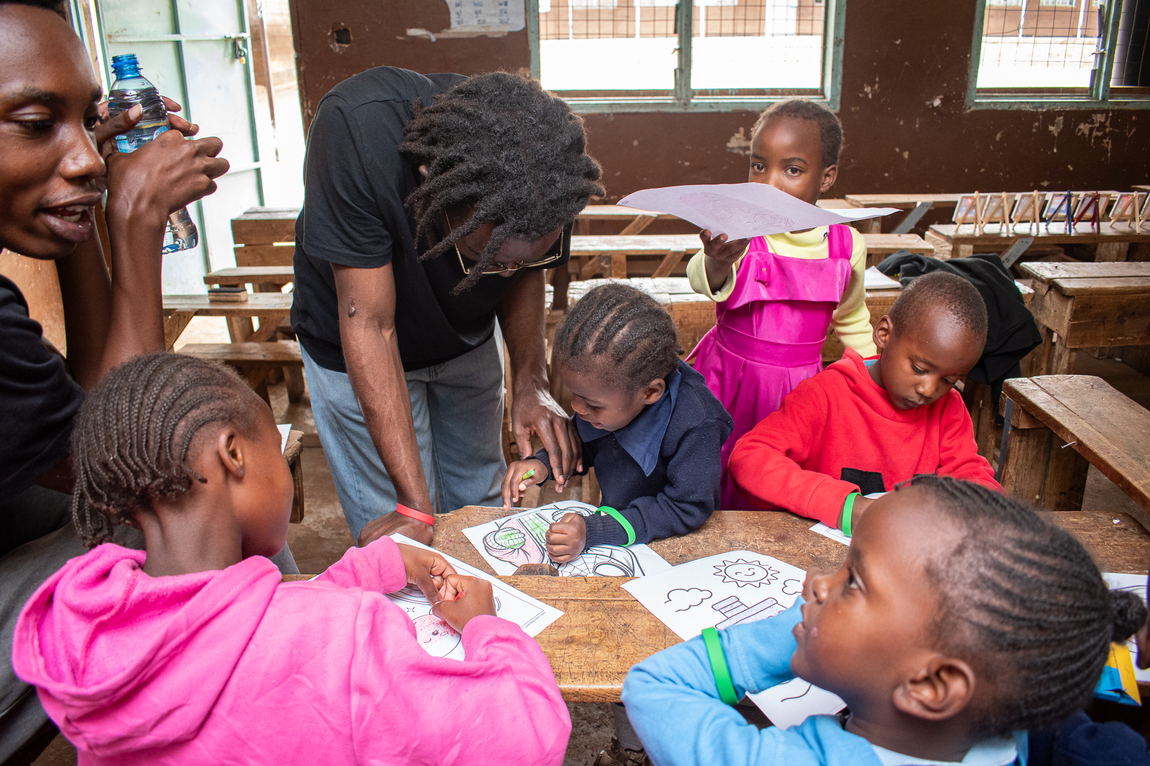
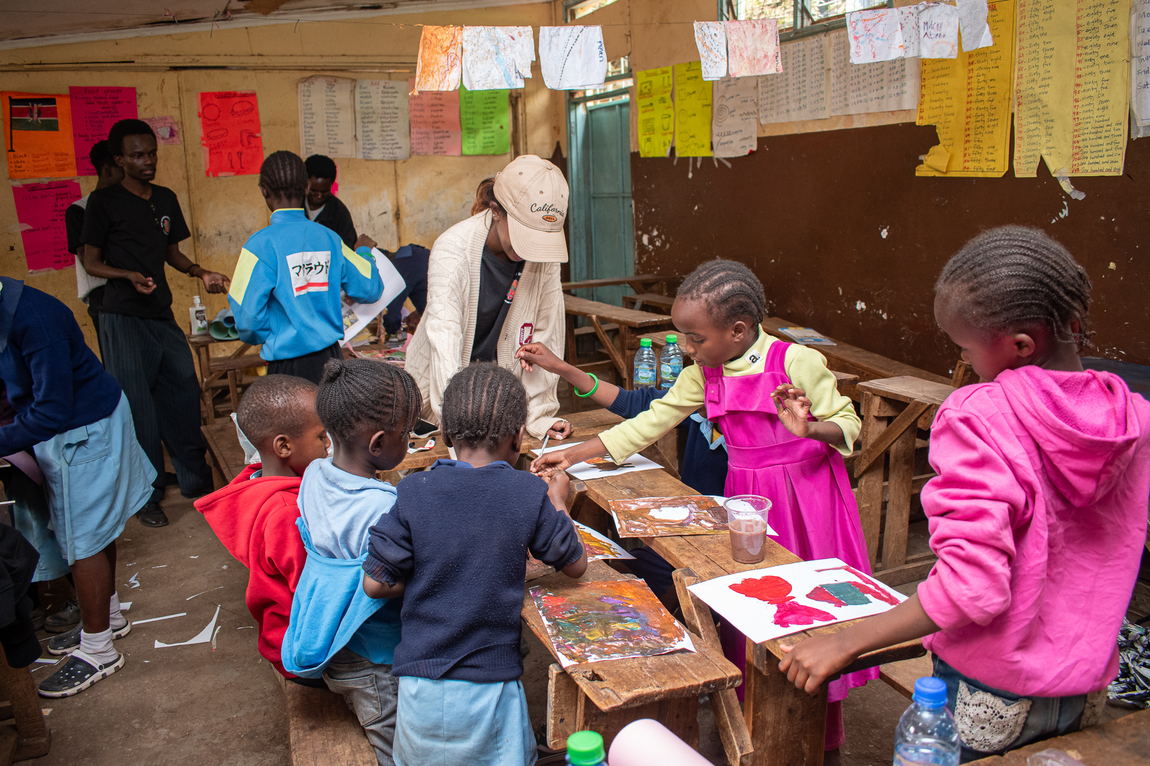
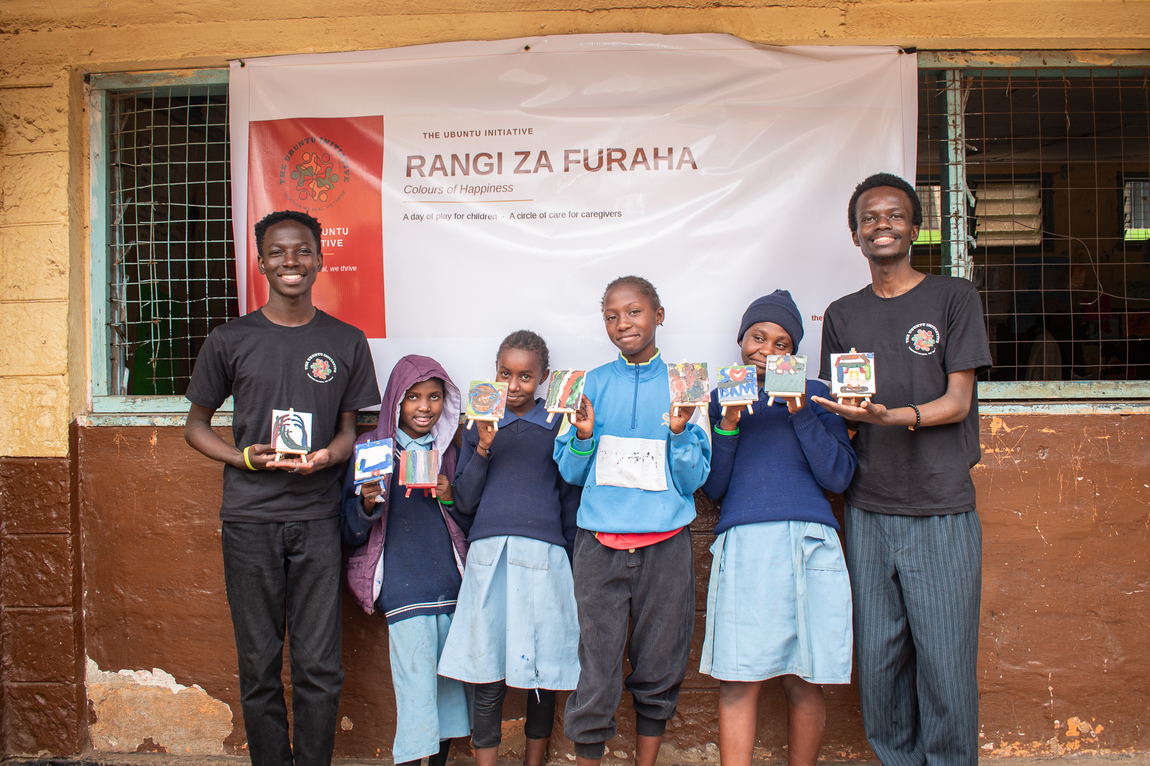
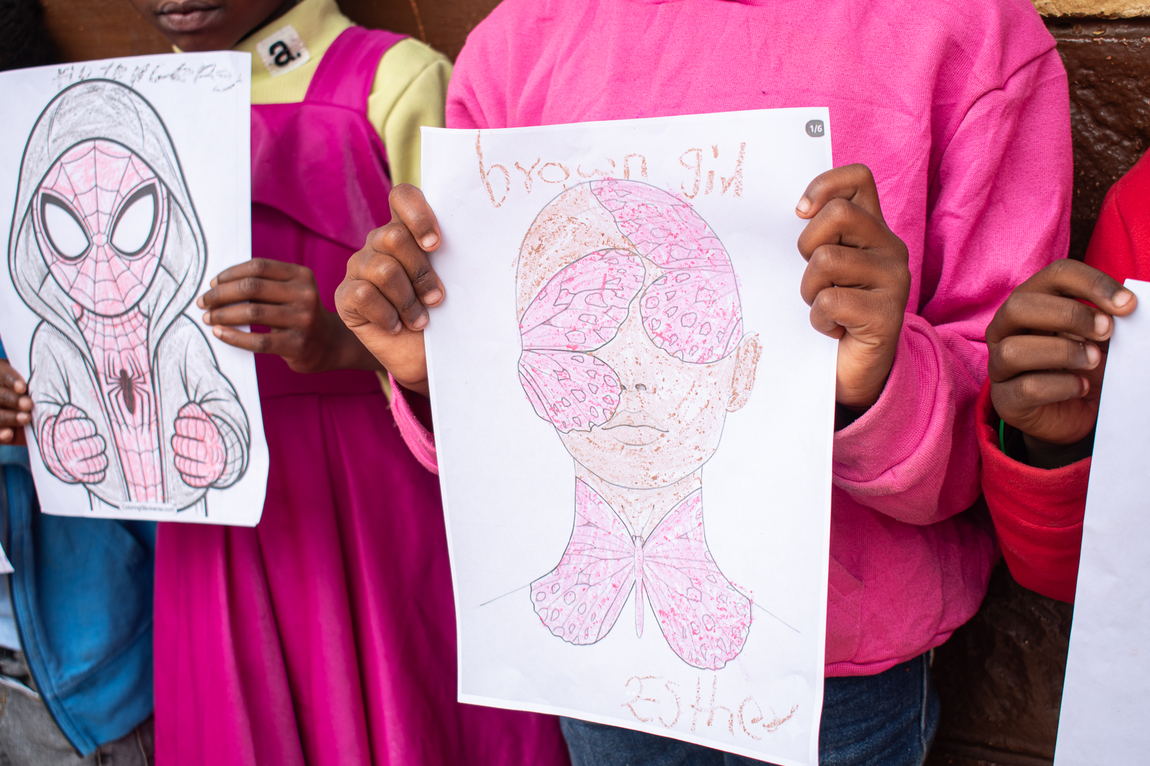
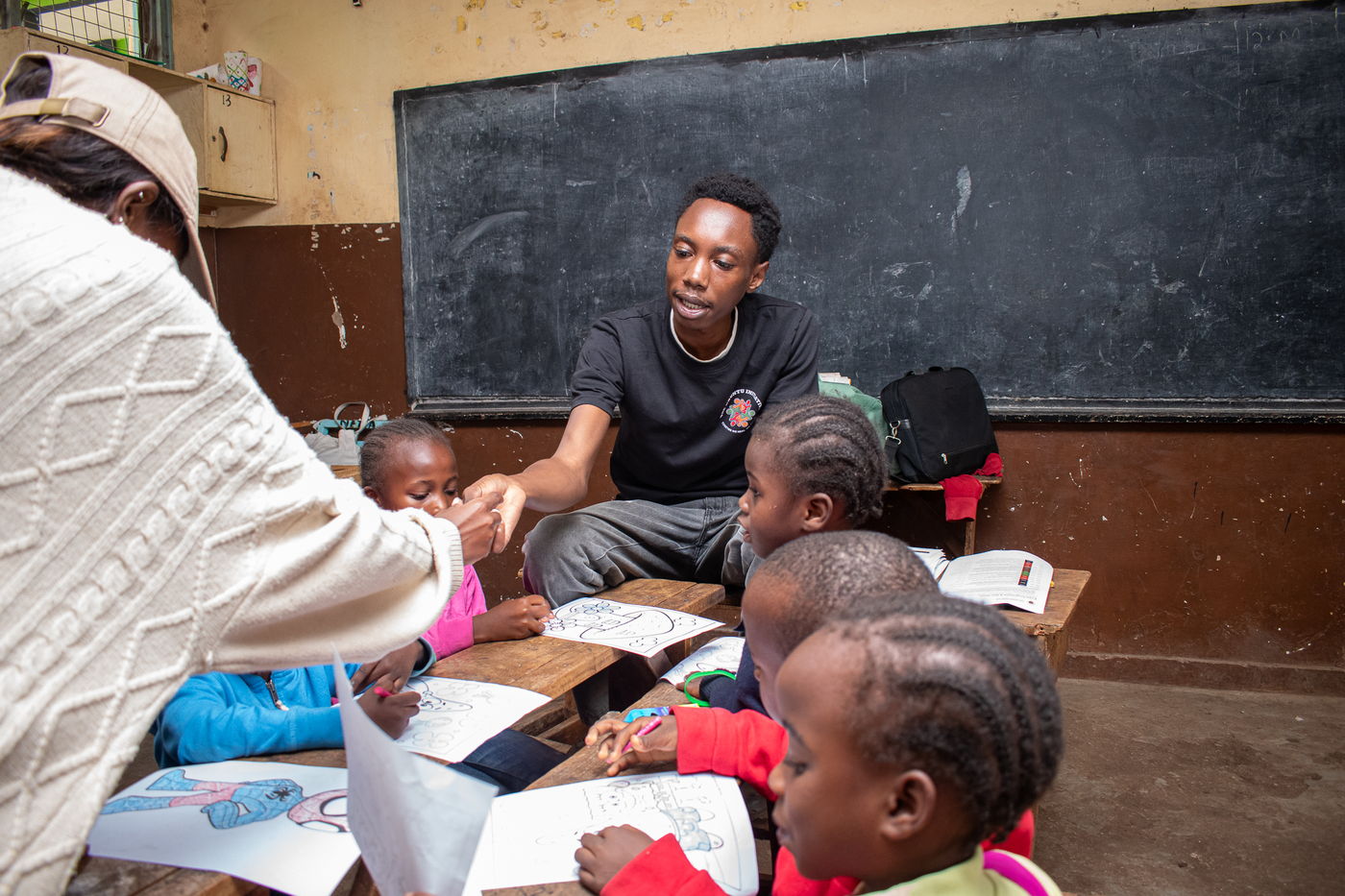
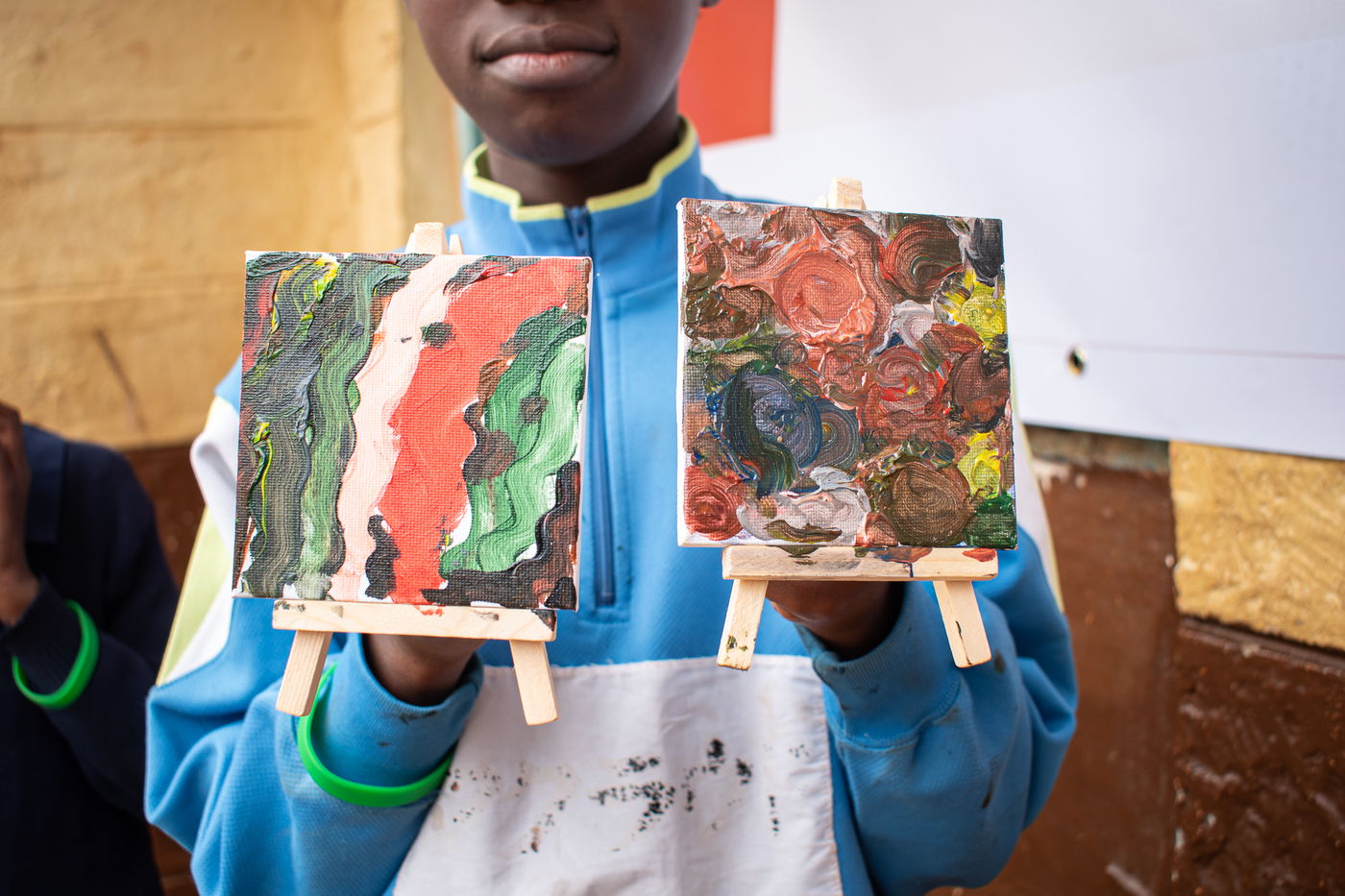
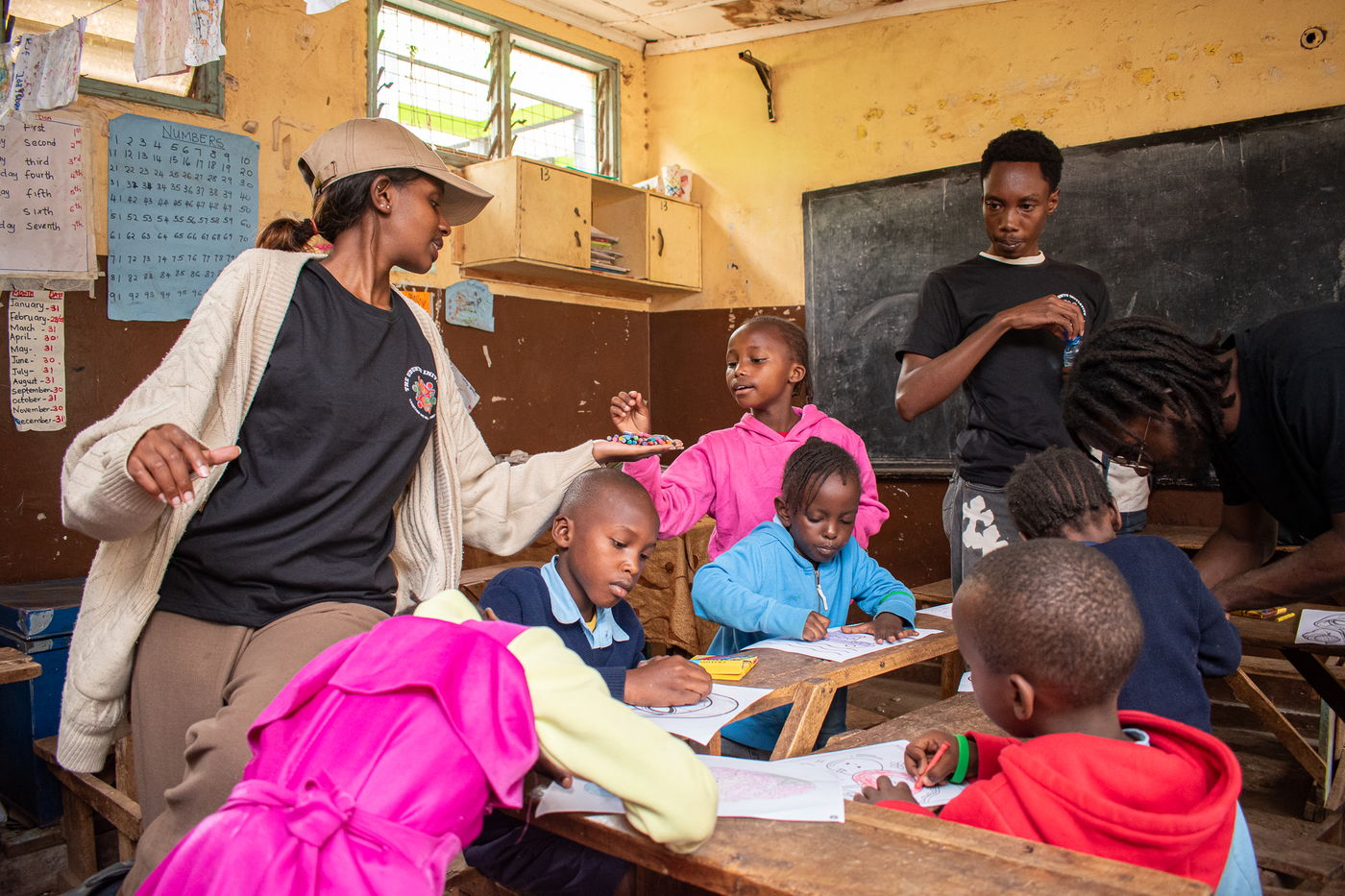
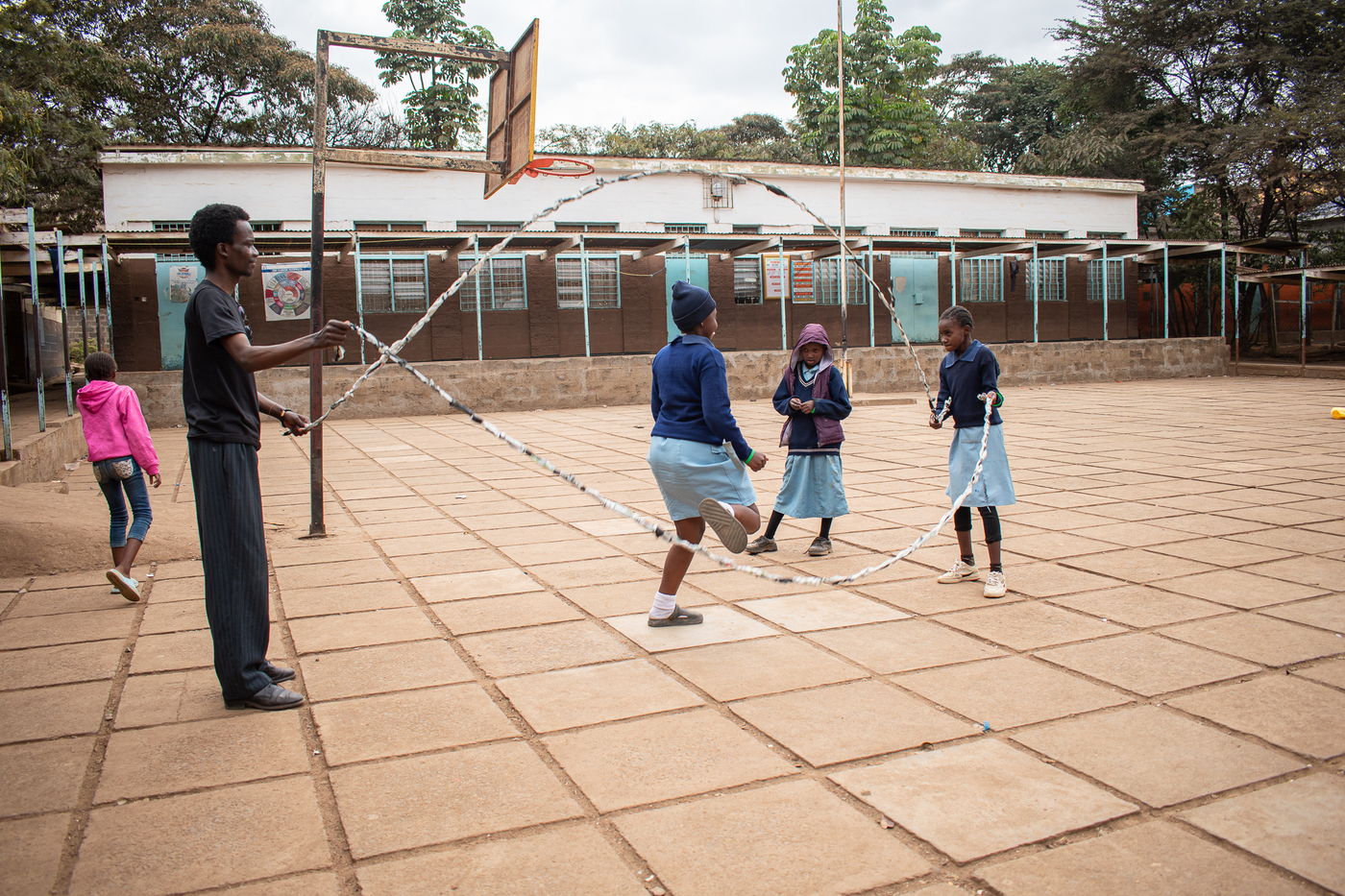
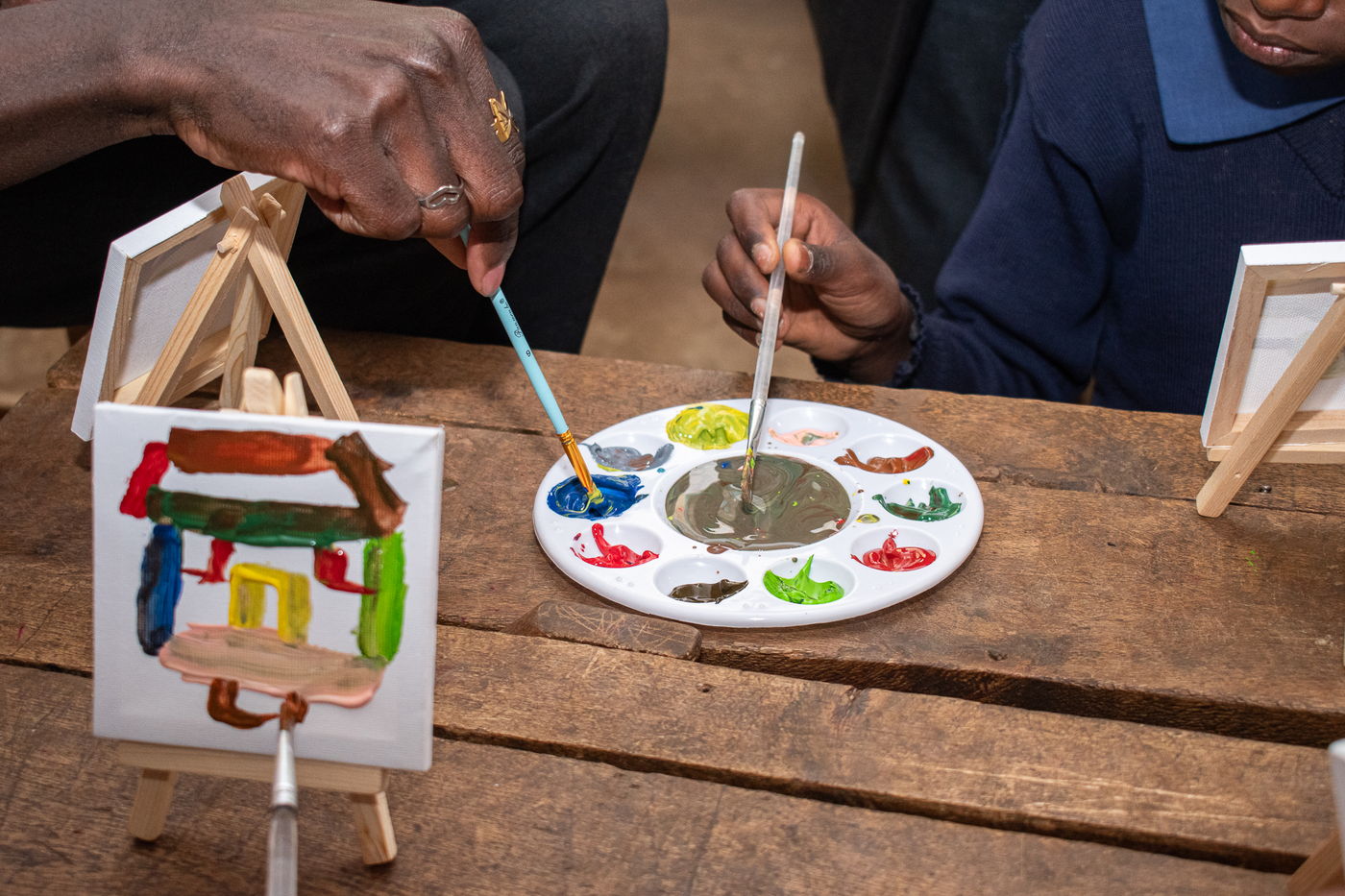
Children move into groups matched to their stage. Colouring, collage, zine-making, bracelet craft, canvas painting, plus skipping and dance in the courtyard. Play is the method, not the reward.
In a private room a few metres away, caregivers sit in a facilitated PFA circle led by our in-house psychologist. Space to be asked, honestly, how they are actually doing, and a referral pathway for when the answer needs more than a morning.
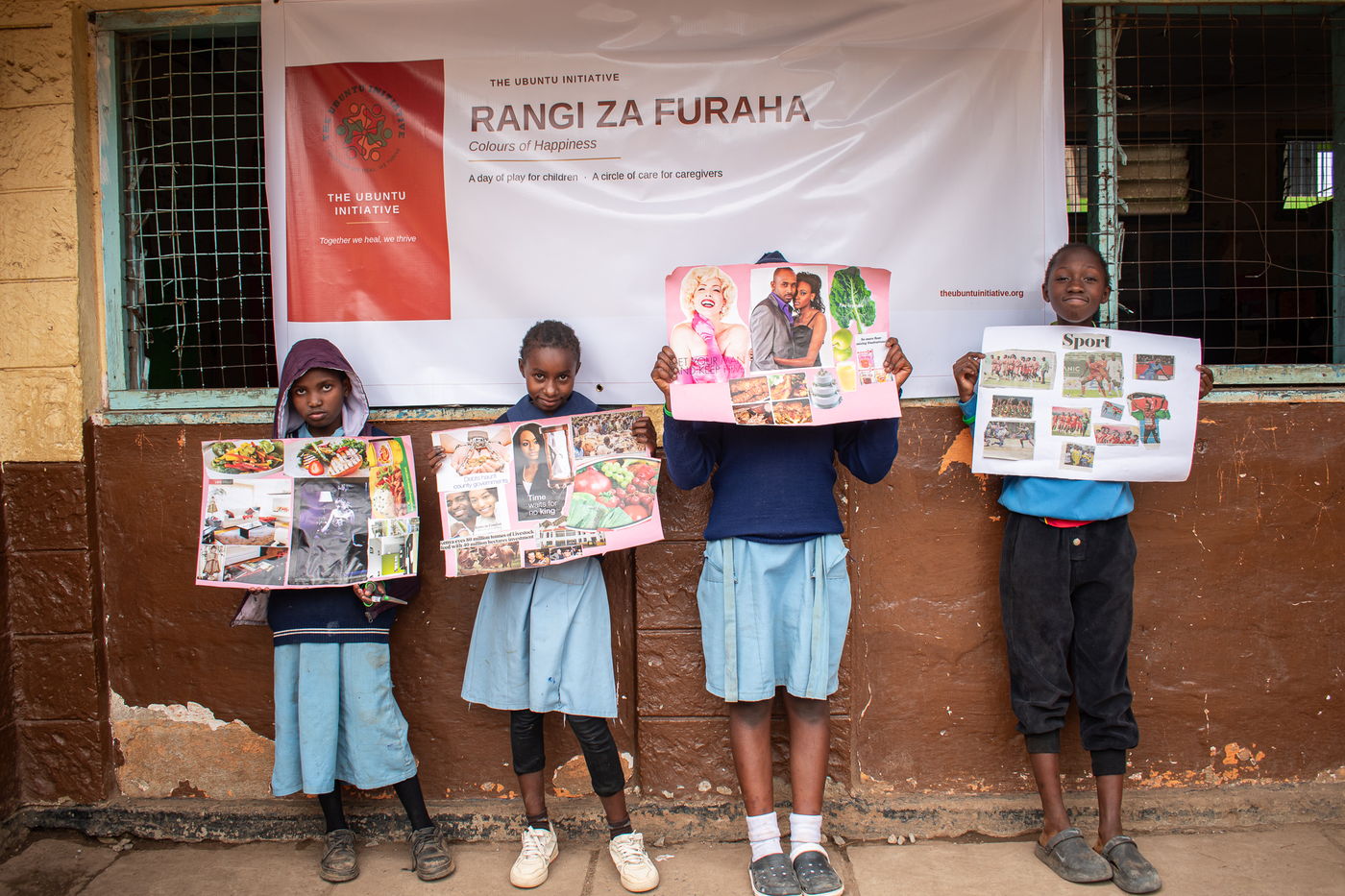
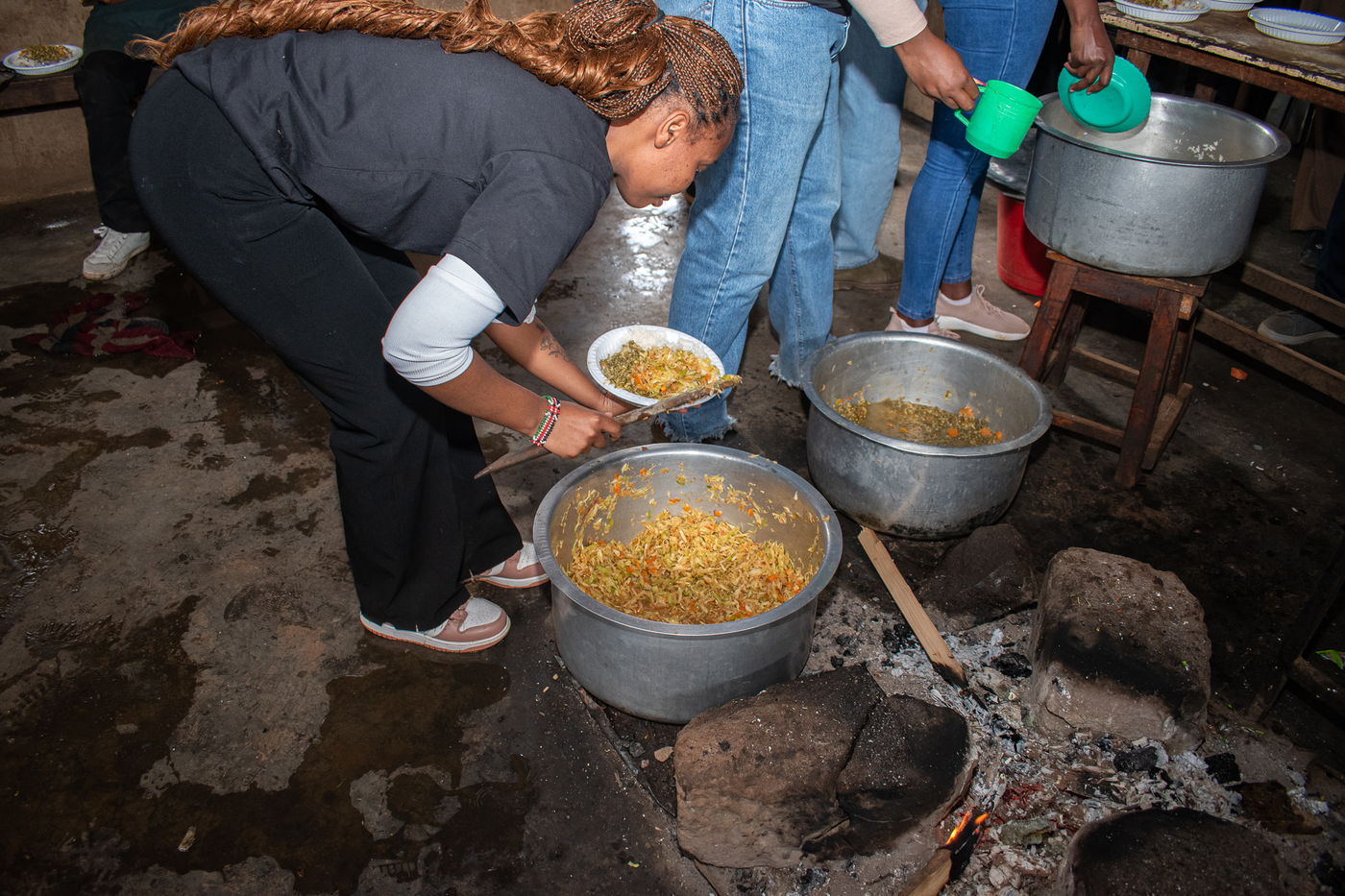
Volunteers cook and serve lunch to everyone present: children, caregivers, teachers, guests and team alike. The children’s artwork is displayed while people eat.
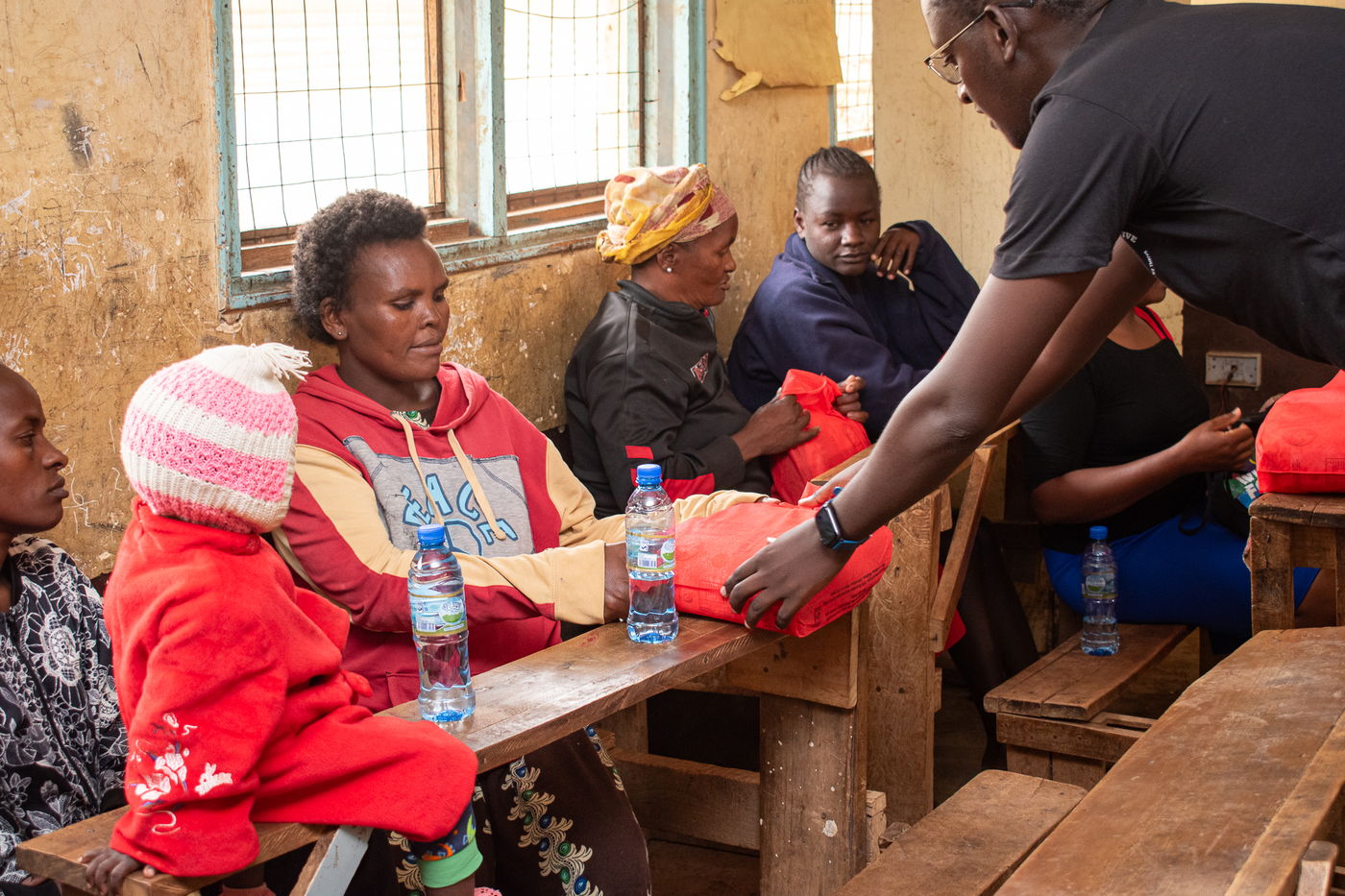
No child leaves without a caregiver signing them out. Every household leaves with a care package, every caregiver’s transport is reimbursed in cash against a signed register, and every child takes their own artwork home.
Caregivers in daily-income households cannot attend a session that costs them a day’s work and childcare. Running both tracks at once removes the trade-off that keeps them away.
Families meet us once and are served twice. That is what turns a one-off event into a relationship a community will show up for again.
One venue, one meal, one volunteer team, one logistics run, serving two generations. The marginal cost of the second generation is close to nothing.
Our model did not begin with a theory. It began with volunteers walking into more than 200 households across Nairobi’s poly-crisis settlements and asking what was actually happening inside them.
A stressed caregiver has less to give a developing child. A struggling child deepens the caregiver’s stress. Treat one without the other and the cycle simply resets.
When caregivers are overwhelmed, children feel it. When children lack safe spaces to play, learn and develop, caregivers carry another burden. Four commitments shape how we respond.
Child development and caregiver wellbeing are addressed together, rather than treated as isolated challenges.
We build with communities, working alongside caregivers, schools, local leaders and the structures that already exist.
We listen to participants, document what we learn, and use community feedback to continuously strengthen our programmes.
We are developing a model that can be tested, refined and adapted across underserved and crisis-affected communities.
Colours of Happiness. On 25 July 2026 we ran our first flagship community day at Kayole 1 Primary School, under written authorization from the Department of Children Services. It was the first time the whole model existed outside a plan.
It was more than an event. It was our first chance to test the model, learn from it and strengthen it. We delivered the whole day for KSh 45,950, roughly USD 356, entirely from our own resources and 8% under the cap we set ourselves. That works out at about KSh 1,436, roughly USD 11, for every person we reached.
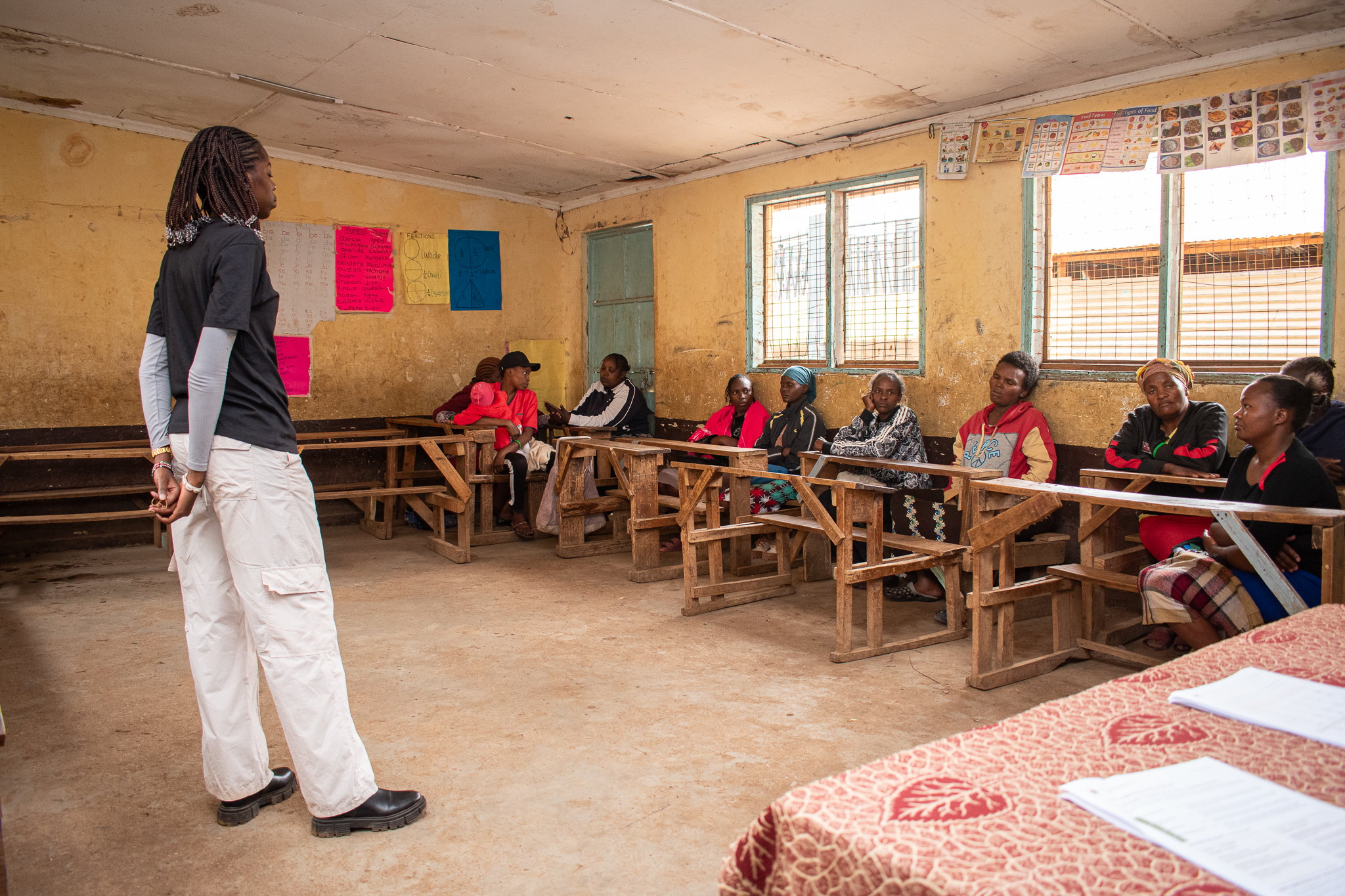
While the children created, eleven caregivers sat in a facilitated Psychosocial First Aid circle led by Melanie Kimberly, our in-house psychologist. It produced a structured needs assessment, the first real evidence base we have ever had, gathered from the people we serve rather than written about them.
What surfaced was not what we expected. Caregivers did not lead with money. They led with isolation, with the weight of holding a family together unwitnessed, and with children whose needs they could see but could not name. That assessment now shapes our programme design, and it is what convinced us the second half of this model is not an add-on. It is the point.
“The caregiver wellbeing circle reminded me that we also need care as parents. Rangi za Furaha was truly more than just an activity for children. It created a very safe space where families can learn and connect.”
Mary Mwende · caregiver, wellbeing-circle participantResponsive-caregiving support delivered through the adult: sensory play, talk, song and attachment-building coaching in the circle alongside their caregiver.
Guided colouring, sensory and imaginative play, songs and movement. This builds language, fine motor control and the first skills of naming a feeling.
More complex colouring, collage and modelling, group games, skipping and dance. Cooperation, turn-taking, and confidence in a room full of other children.
Zine-making, canvas painting and themed collage such as “picture my dream life”, plus bracelet craft around virtues like hope and kindness. Aspiration made visible.
Our first flagship day reached 21 children: three aged 3 to 5, eight aged 6 to 9, and ten aged 10 to 12. The 0 to 2 tier is designed and funded in our programme plan, and will run as we scale.
In the settlements we work in, a child with Attention Deficit Hyperactivity Disorder (ADHD), or autism, dyslexia, or any other neurodivergent condition, is rarely described that way. They are described as stubborn, slow, rude, distracted. They are punished for a brain that works differently, and the years in which early support would have changed everything pass without anyone naming what is happening.
The gap is not that support is refused. It is that nobody around the child, caregiver or teacher, has ever been shown what the early signs look like. So there is nothing to refer.
Practical training for caregivers and teachers on recognising the early signs of Attention Deficit Hyperactivity Disorder (ADHD) and other neurodivergent conditions, what to do next, and how to respond without shaming the child.
Our flagship day already gathers the child, the caregiver and the school in one place, with a psychologist present. It is the natural delivery point for early identification, and it needs no new infrastructure.
I grew up with undiagnosed Attention Deficit Hyperactivity Disorder and anxiety. I did not find out until I was twenty-two. Everything I now know about being misunderstood as a child, I learned by being that child. Ubuntu exists so the next one gets named earlier.
James Victor Warano Mutune · Founder & CEOWe are honest about the stage this is at. Early identification is a designed programme direction shaped by lived experience and by what caregivers told us in our first needs assessment. It is not yet a delivered service. We are seeking clinical partners and funding to build it properly, with the right expertise, rather than quickly.
For most of my childhood I was the problem in the room. Not the child with a problem. The problem itself. I could not sit still. I could not hold attention where it was demanded of me, though I could disappear for hours into something that had caught me. I lost things, forgot things, interrupted people, started before I had finished listening. I could not explain any of it, because I did not know there was anything to explain.
The adults around me were not cruel. They simply had no framework for what they were looking at, and neither did I. So the explanations available were the ordinary ones: careless, rude, bright but lazy, does not apply himself. I heard them often enough to believe them. That is the part people underestimate. A child does not just receive those words, a child becomes them.
I was twenty-two when I learned the words for it: Attention Deficit Hyperactivity Disorder (ADHD), and the anxiety that had grown up alongside it. ADHD is a neurodevelopmental condition. It shapes how the brain manages attention, impulse and activity. It is not a deficit of character or of intelligence, and it is not something a child outgrows by being told to concentrate. It is also, when it is recognised early, one of the most supportable conditions there is.
Nobody recognised mine. The relief of finally having language was enormous, but so was the grief, because I understood in the same moment how many years had been spent being managed instead of being understood. I think about that gap constantly. Not with bitterness. With urgency.
Ubuntu came out of that gap. But the more time I spent in Nairobi’s settlements, the clearer it became that the child is only half the story. Behind almost every struggling child is an adult who is exhausted, isolated and carrying more than anyone has ever asked them about. You cannot fix one and ignore the other. The Zulu word ubuntu, I am because we are, is not decoration on our name. It is the operating instruction.
We are young, and we say so. What we are not is unserious. We registered properly, we asked before we assumed, we delivered our first flagship day on our own money, and we accounted for every shilling of it. That is the standard we intend to keep as we grow.
A young organization asking for money owes its funders more evidence, not less. Everything below was in place for our first flagship day, before anyone had funded us to do it.
Written authorization from the Department of Children Services before a single child took part, with the Office of the Chief and the Sub-County Children’s Office represented on the day.
Vetted volunteers, adults never alone with children, signed caregiver sign-out, and colour-coded photography-consent wristbands so consent is visible rather than filed.
A published budget, wholesale sourcing, sealed-envelope cash control and a signed reimbursement register. Our first day closed 8% under its own cap, at KSh 1,436 (USD 11) per beneficiary.
Attendance registers, caregiver wellbeing measures at baseline, midline and endline, facilitator thematic reports, and quarterly learning reviews reported to funders.
Testimonials collected on signed consent forms that explicitly authorise use in reporting. Findings from the wellbeing circle are reported in anonymised, aggregate form only.
We planned for 30 children and 21 caregivers; 21 and 11 came. We report what happened, not what we hoped for, and we have budgeted a community mobiliser at every site because of it.
We built our model around what our own community told us. We aligned it with the frameworks the early childhood and humanitarian sectors already trust, so that what we do is legible to governments and funders, and so we are not reinventing what has been settled.
The global roadmap for early childhood development, built on responsive caregiving and early learning. Our two-generation design maps directly onto it.
The internationally recognised approach to supporting people in distress, and the basis of how our caregiver circles are structured and facilitated.
Inter-Agency Standing Committee guidance on mental health and psychosocial support in crisis settings, which shapes how we work in poly-crisis communities.
The evidence that play drives cognitive, social and emotional development. It is the reason our sessions are built on play rather than instruction.
Why sustained adversity in early childhood alters development, and why a supported adult relationship is the single strongest buffer against it.
Our work sits inside Kenya’s own development priorities for health and education, delivered through public schools and local government structures.
These frameworks inform our design; they are not endorsements of our organization. Independent evaluation of our own model is a funded priority in our next programme phase, and we would welcome technical partners in doing it properly.
Numbers persuade a committee. Watching a child hold up something they made persuades a person. Our first documentary was filmed at Rangi za Furaha and is in production now.
Filmed on the day by our videographer, Joshua Nzinga, for the funders, partners and neighbours who were not in the room.
“Two children will be born today. One in the squalor of Kayole; another in the opulence of Beverly Hills. Both are heirs, only one inherits adversity, as the other inherits splendor.”
Our Communications Lead spent the day at Kayole 1 Primary School and wrote what he saw. Joseph, quiet and reluctant at first, drew still life that was gorgeous and impressive. A caregiver session painted a sober picture of the systems meant to serve these families. And running through all of it, one argument: that a child’s world and the world of the person raising them were never meant to be held separately.
Read the essayRooted in the community we serve, and united by one belief: we heal together.
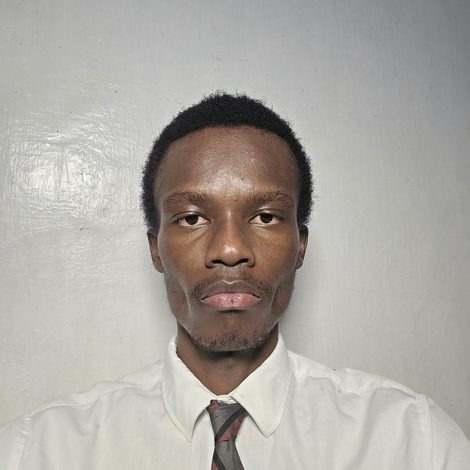
Lived-experience leader and social entrepreneur. An international relations and development student and Aspire Leaders Program alumnus, he founded Ubuntu and leads its two-generation model.

Keeps Ubuntu organized and accountable, coordinating governance, records and the day-to-day rhythms that keep our work running smoothly.
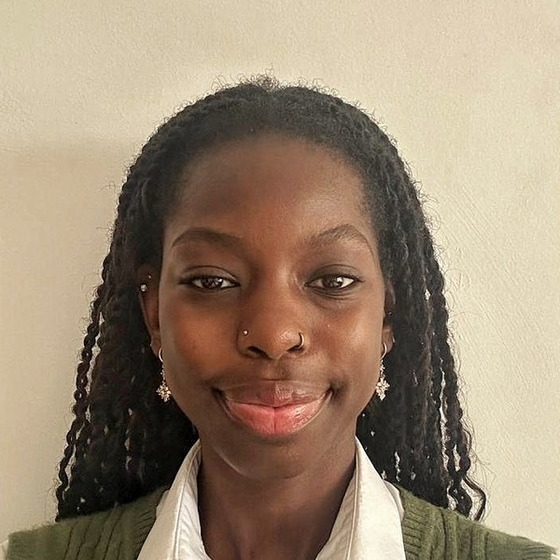
Leads Ubuntu’s psychosocial practice, holding the caregiver circles and grounding our work in trauma-informed, evidence-based mental health care. She facilitated the Psychosocial First Aid session at Rangi za Furaha.
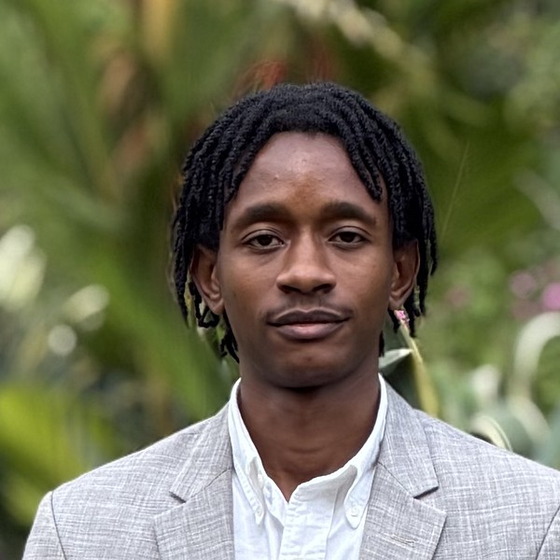
Documents Ubuntu’s work in the field. Every photograph and frame from Rangi za Furaha is his, shot under our consent protocol, and the reason funders and neighbours can see the day rather than be told about it.
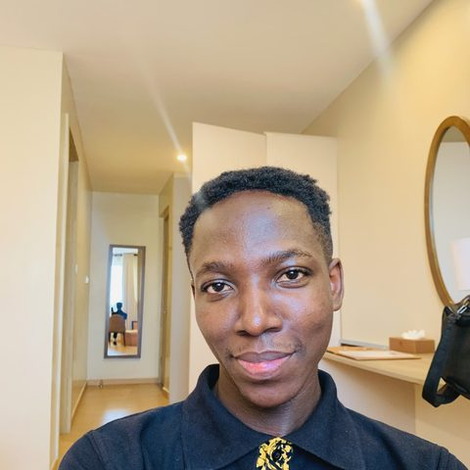
An accredited media practitioner with a degree in journalism and mass communication. Shapes how Ubuntu tells its story across media relations, content, graphic design and contemporary storytelling.

Safeguards Ubuntu’s finances and transparency, bringing more than five years of professional experience to our stewardship and accountability.
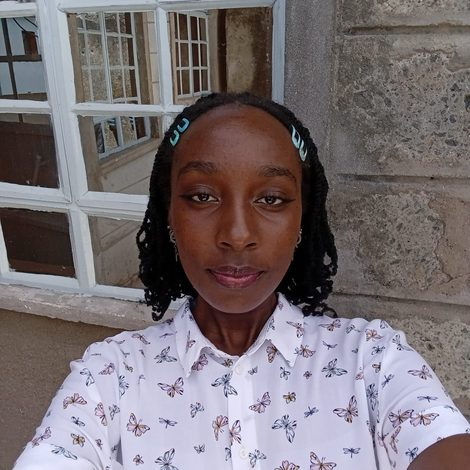
Builds and cares for the volunteer team: recruitment, vetting, onboarding, and the culture that keeps people coming back.
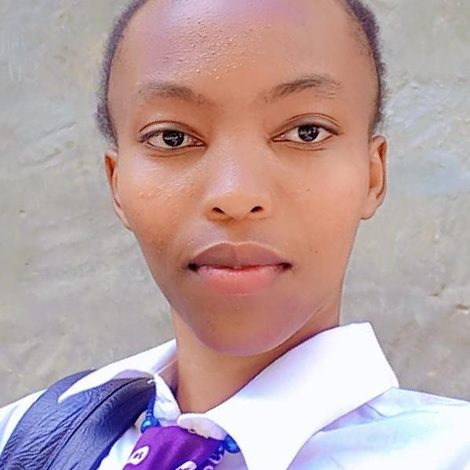
Keeps Ubuntu’s digital presence and design language consistent, accessible and true to the communities we work in.
Supports the tools and systems that keep our records, registers and reporting organised as the programme grows.
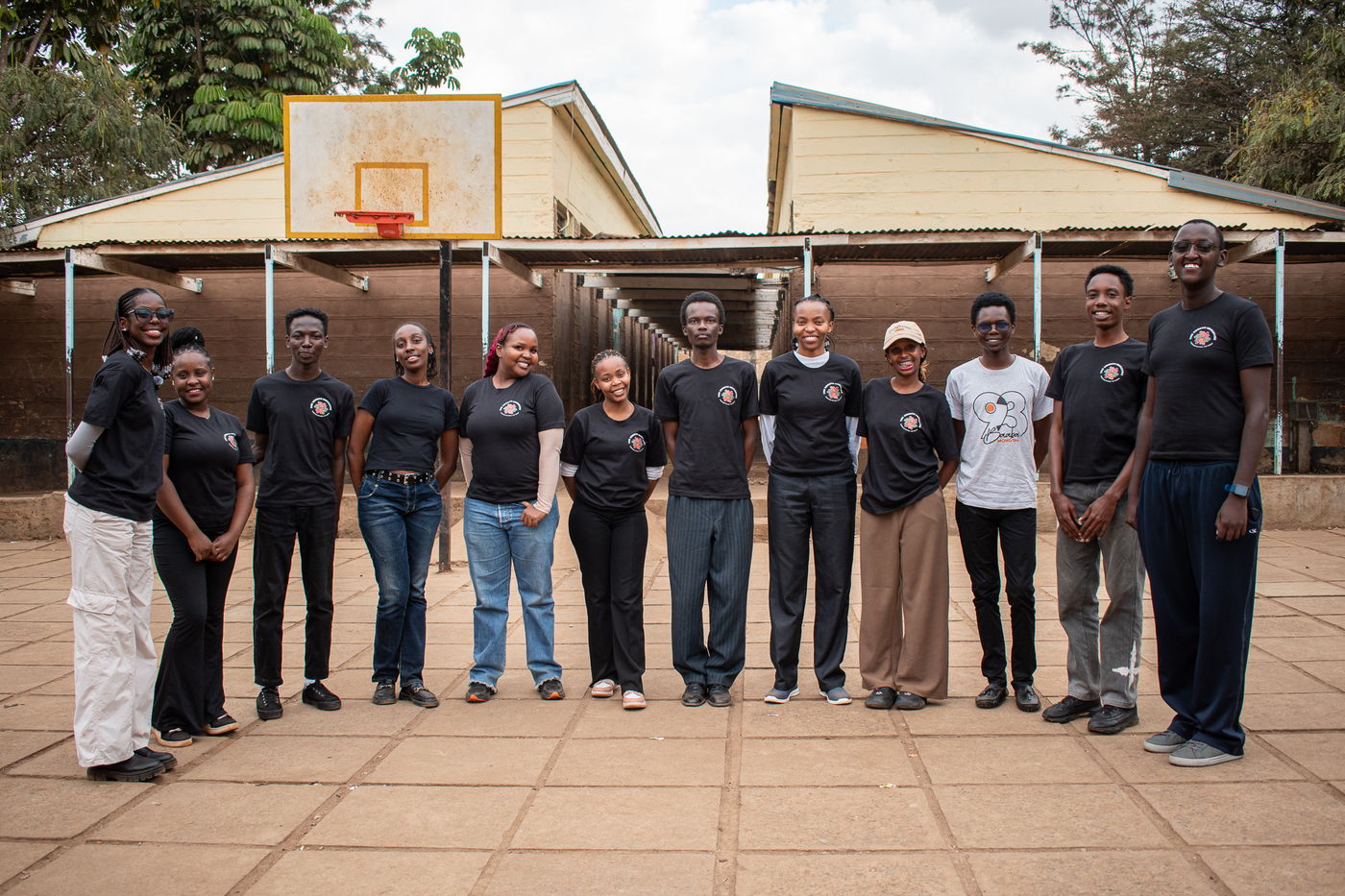
Station facilitators, first aiders, cooks and mobilisers, most of them young people from the communities we serve. They are the delivery engine of everything we scale next.
Every milestone marked delivered below is real and documented. Everything marked planned is exactly that. We think the difference matters.
We are looking for funders, technical partners and institutions who want to back a two-generation model that has already been delivered, documented and accounted for. If that sounds like you, we would like to talk properly.
A full Rangi za Furaha™ day for a whole community. This is what our first one actually cost, receipts and all.
Three flagship days plus the caregiver circles that run between them, so one community stays connected rather than visited once.
Six flagship days, the circles between them, a trained volunteer cohort, and the measurement that tells us whether it worked.
Three sites over three years, reaching at least 1,800 children and caregivers, with independent evaluation built in.
Every figure above comes from our audited pilot cost or our costed three-year programme budget. US dollar figures are indicative, converted at KES 129 to USD 1.
We read everything that comes in and will come back to you as soon as we can.
James Victor Warano Mutune · Founder & CEO
We had planned the circle carefully. We had not planned for what came out of it.
On the morning of 25 July, while twenty-one children were three doors down turning blank canvases into something bright and entirely their own, eleven caregivers sat in a classroom at Kayole 1 Primary School with Melanie Kimberly, our in-house psychologist. The session was built on Psychosocial First Aid, a structured, internationally recognised way of supporting people under strain. No lecture. No forms to start with. Just a facilitated circle, and a question most of them had not been asked in years.
How are you, actually?
I want to be honest about my own assumption going in. I expected money. I expected school fees, rent, the price of unga. Those things are real and they came up. But they were not what people led with.
What they named first was being alone in it.
Not alone as in unmarried, or without neighbours. Alone as in unwitnessed. Holding a household together every single day, making decisions with no margin for error, and having nobody ask how that feels. One caregiver said the thing that has stayed with me longest: that she had not realised other people were carrying the same thing until she heard someone else say it out loud in that room.
Isolation outranked income. Financial stress was the context of everyone’s life, but the relief people described was social. Being in a room where the experience was shared and normal. That is a very cheap thing to provide and we had been treating it as a side effect rather than a service.
Caregivers could see their children’s needs but had no language for them. Several described a child who struggled at school, could not settle, was called difficult by teachers. They knew something was happening. They had no framework and no route to anyone who did. This is the gap that our neurodivergence work is being built to close, and it did not come from a strategy session. It came from this room.
Not one father was present. Eleven caregivers, and every one of them a woman. We have written separately about what that absence means, because it deserves more than a line here.
Three things, immediately. We stopped describing the caregiver circle as the supporting half of the day. It is not. It is half the point. We committed to continuity, because a single circle opens something that a single circle cannot then hold; the same cohorts now meet again between flagship days. And we budgeted a community mobiliser at every site, because we had planned for twenty-one caregivers and eleven came, and in a daily-income community that gap is not indifference. It is logistics.
The full needs assessment is documented and held on file. Findings are reported in anonymised, aggregate form only, and nothing in this note identifies anyone who sat in that room.
Rangi za Furaha™ · Kayole 1 Primary School, Embakasi Central, 25 July 2026. The wellbeing circle was facilitated by Melanie Kimberly, psychologist.
The Ubuntu Initiative
Before Rangi za Furaha had a name, there was a Saturday in Soweto that taught us what the model needed to become.
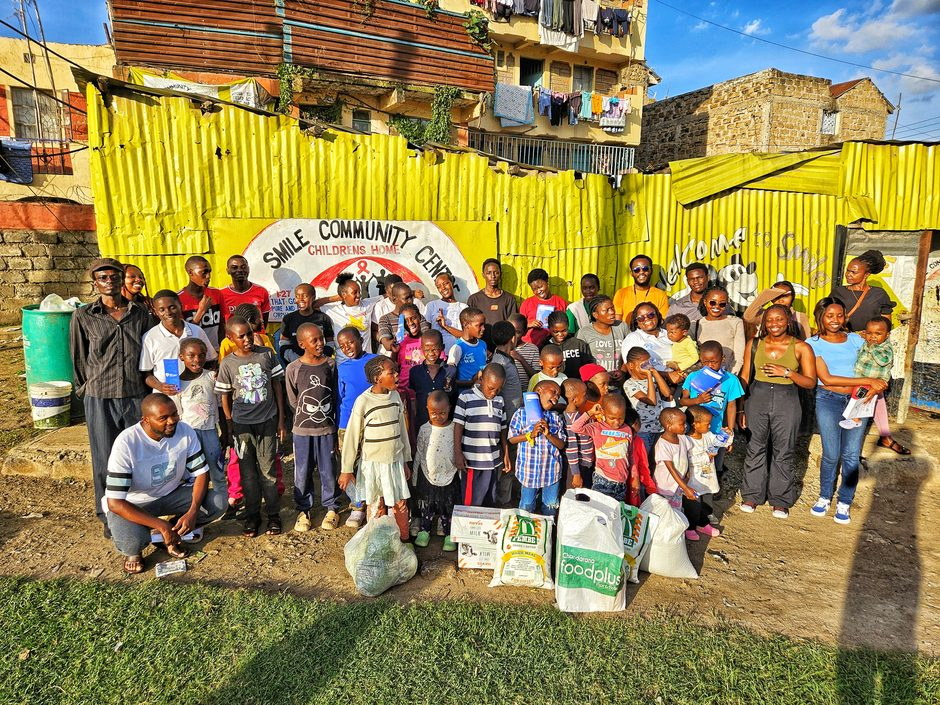
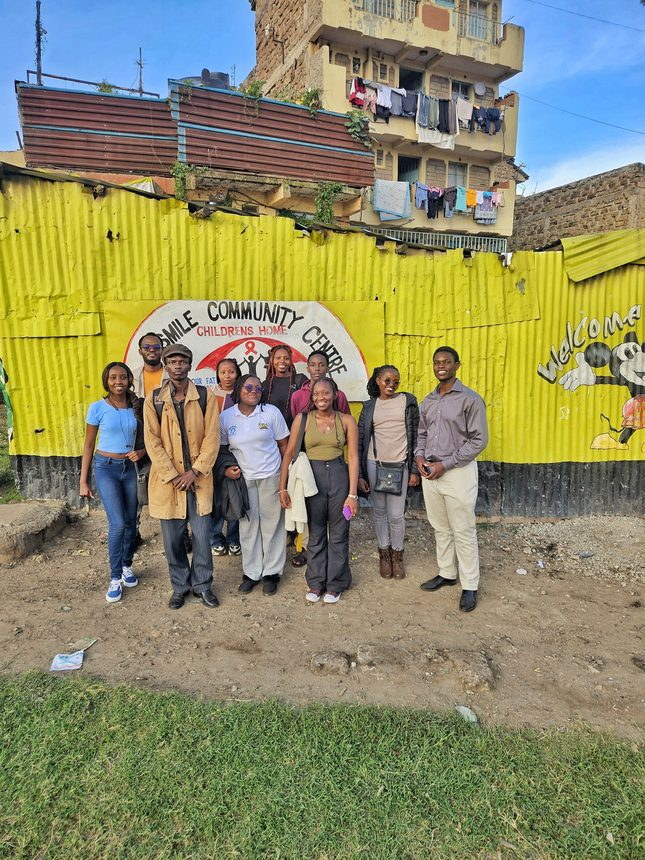
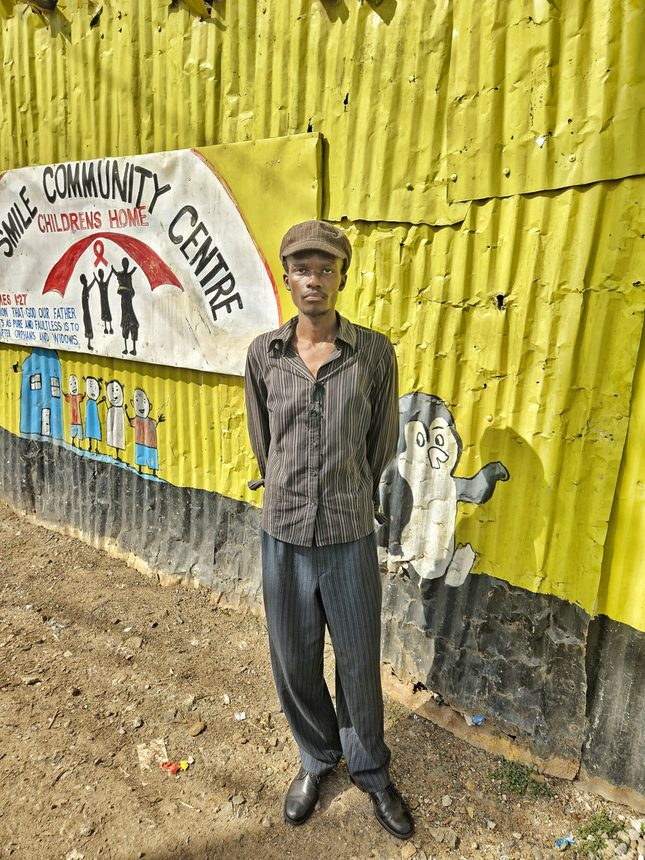
In March 2026 our volunteers spent the day at Smile Community Centre Children’s Home in Soweto, Nairobi. The plan was modest: play, art, a shared meal, and some supplies for the home. What we came away with was a much clearer sense of what we were actually building.
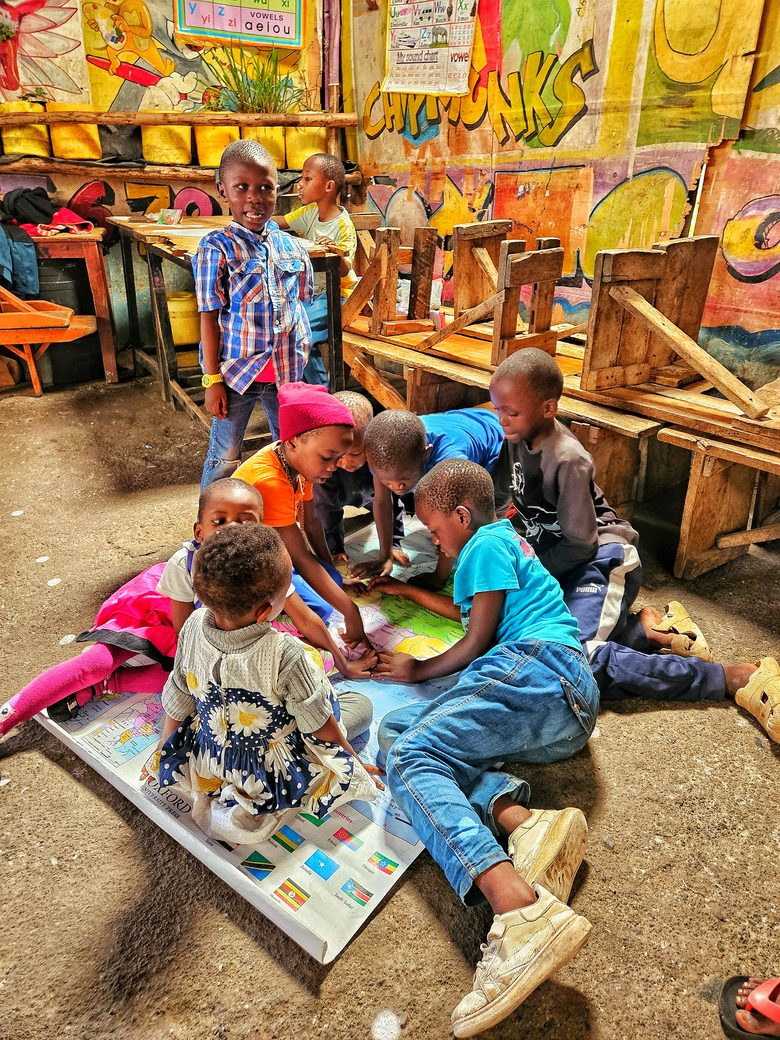
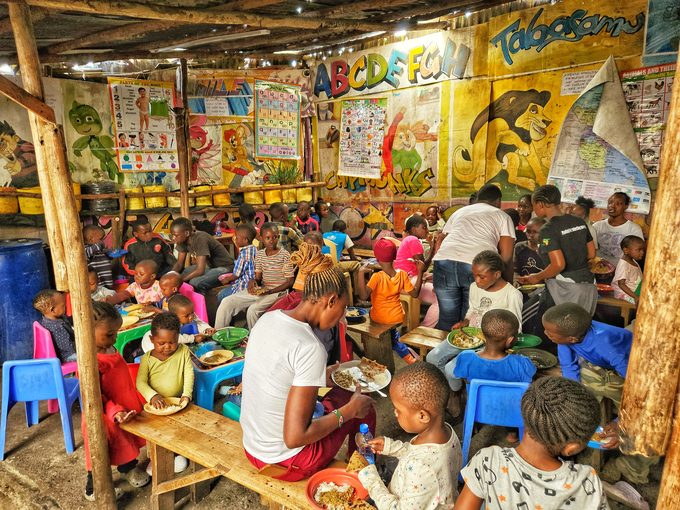
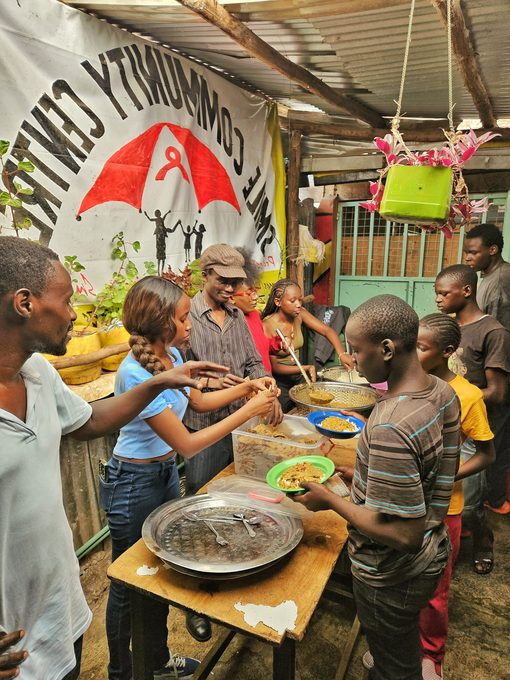
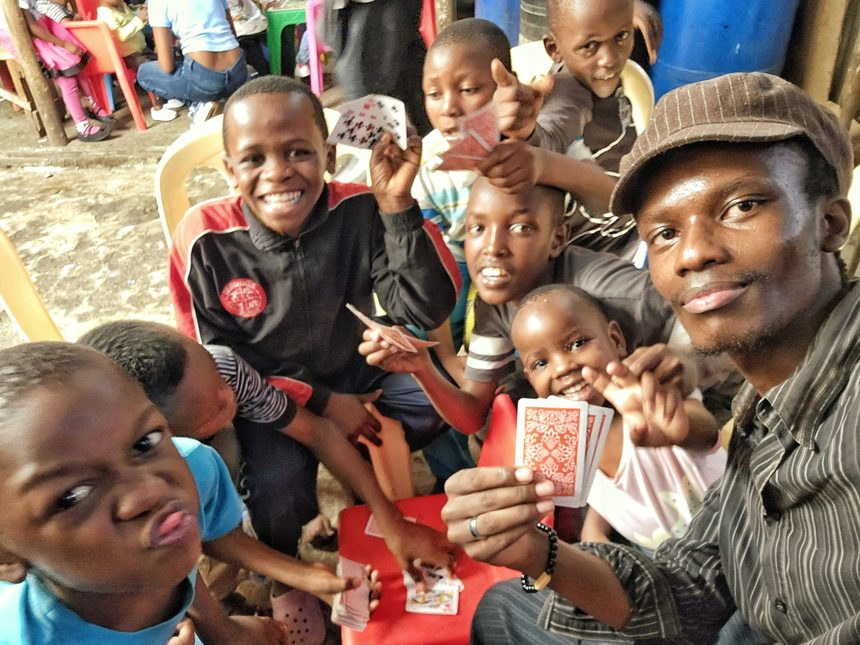
The children did what children do when adults arrive with time rather than instructions. They tested us for about ten minutes, decided we were staying, and then took over. There were games on the floor, drawings passed across tables for approval, and the particular noise a room makes when nobody in it is being managed.
Play is not the reward for the serious work. Play is the serious work.
We shared a meal. We left supplies. And on the way home we talked about the thing that had been nagging at all of us: the adults. The staff at the centre carry enormous weight, and so do the caregivers of every child who is not in institutional care. We had spent a wonderful day supporting children and had offered nothing at all to the people holding them up.
That conversation is the direct ancestor of the dual-focus model. Four months later, at Kayole 1 Primary School, we ran the first day where both generations were served at once. This is where that idea started.
Smile Community Centre Children’s Home, Soweto, Nairobi · March 2026.
James Victor Warano Mutune · Founder & CEO
Eleven caregivers came to our wellbeing circle. Every one of them was a woman. I have thought about that more than almost anything else from the day.
It would be easy to write that sentence as a complaint about absent fathers. It is not. It is a question about who we, collectively, have decided counts as a caregiver, and who has been quietly excused from the category, or quietly locked out of it.
When we say caregiver in this sector, we almost always mean mother. Our materials say it. Our session times assume it. The venues we choose, the language we use, the hours we run. All of it is built, without anyone deciding to, around women. So when no father appears, the system gets to record it as his failure rather than as its own design.
A man who has never once been invited has not declined.
There is a second layer underneath. Men in these communities are under real strain, and there is almost nowhere for it to go. The expectation is provision, not expression. A man who says he is struggling risks being heard as a man who is failing. So the strain stays inside, and it comes out in the places strain comes out: in health, in absence, in households.
I write this as someone who spent twenty-two years without language for what was happening in his own head, and who knows exactly what silence costs. The caregiver circle worked at Kayole because it gave people a room where saying the true thing was normal. I do not believe that need is gendered. I believe the invitation has been.
We are not going to announce a men’s programme we have not designed. That is not how we work. But three things are now on our list, and we are saying them publicly so we can be held to them.
First, our mobilisation will invite households, not mothers. The wording matters more than people think. Second, we will ask, in our own needs assessments, what would make it possible for a father or a male guardian to come, rather than assuming we already know. Third, we will look honestly at our timing, because a session held on a working weekday morning has already chosen its audience.
Ubuntu means I am because we are. If that is true, it is true of the person in the household we have not thought to ask about.
Written following the caregiver wellbeing circle at Rangi za Furaha™, Kayole 1 Primary School, 25 July 2026.
Compiled by James Victor Warano Mutune · Founder & CEO
Everything we did on 25 July 2026, written down and open to inspection.
We believe a young organization asking for money owes its funders more evidence, not less. The full report on our first flagship day runs to eleven pages with signed annexes, and it is available to funders and partners on request.
The programme as delivered. The full run of the day, hour by hour, including who attended from local government and what each part of the day was designed to do.
Who we reached. A complete headcount broken down by age tier: 21 children (3 aged 3-5, 8 aged 6-9, 10 aged 10-12), 11 caregivers, 15 volunteers, 2 teachers and 2 guests of honour. Fifty-one people on site, 32 direct beneficiaries.
The caregiver wellbeing circle. How the Psychosocial First Aid session was structured and facilitated, and what the needs assessment produced, in anonymised form.
An itemised budget. Every line of the KSh 45,950 (USD 356) we spent, against a self-imposed cap of KSh 50,000 (USD 388), with the sourcing approach and the cash-accountability method set out in full.
Safeguarding standards. The protocol we worked to, including vetting, adult supervision rules, signed caregiver sign-out, and the colour-coded photography-consent wristbands.
What we learned, including where we fell short. We planned for 30 children and 21 caregivers. Twenty-one and eleven came. The report says so, and explains what we changed as a result.
Signed annexes. Government authorization, our registration and training certificates, and three signed community testimonials from a teacher, a caregiver and a volunteer.
To request the full report, or the accompanying concept note, write to theubuntuinitiative.org@gmail.com.
Cleophas Onjweri-Thomas · Communications Lead · Photography by Joshua Nzinga
Choice is overrated. Two children will be born today. One in the squalor of Kayole; another in the opulence of Beverly Hills. Both are heirs, only one inherits adversity, as the other inherits splendor.
Should the former fail at life, do we fault him? This is one such predicament that was witnessed at Kayole 1 Primary School. Children with light in their eyes, and hope in their hearts. Unfortunately, their psychosocial needs are perennially overlooked and underserved. Often considered as the marginalized, the excluded. Excluded in such a manner that they cannot imagine a world outside the disenfranchised socio-economic background they have been raised in.
On the 25th day of July 2026, we got to see the world from the eyes of children. The innocence of the children could be felt from a mile away. To the untrained eye, they appear uptight. As you get familiar with them, you start to notice their strengths and weaknesses, their ambitions and insecurities.
One Joseph was very unassuming, very quiet. Just like any other child would feel seeing “intruders” trying to break the ice with them, he was, at first, quite reluctant. More often than not, he drew still life that was gorgeous and impressive. Even the colouring work he did made him stand out, meticulously having selected a carefully assorted array of colour combinations.
The Psychosocial First Aid session painted a much gloomier picture about the fate of future generations in the locality of Kayole, where parents and caregivers spend their earthly possessions to see their children through school. However, the very systems that are supposed to be at their beck and call are the same systems that have time and again proved unreliable.
Much to the chagrin of many, no father figure of any child was present, which begs the question: are single mothers the only ones considered caregivers?
For the children in Kayole to realize the psychological and community development they are so desperately yearning for, public policy needs radical surgery. Every child should have an equal chance and opportunity to experience quality education and psychosocial support. Caregivers, on the other hand, need avenues such as support groups which regularly meet up to assess and discuss the issues affecting them.
Furthermore, there needs to be robust parent-teacher collaboration, since a teacher is like a secondary parent to the child. Improved relationships between teachers and parents would go a long way in enhancing open communication, building trust and increasing the caregiver’s involvement in their children’s school life.
Rangi za Furaha, Colours of Happiness, is the day The Ubuntu Initiative stopped being an idea carried alone and became something an entire community could stand inside: children painting in one corner, their caregivers finally being asked how they were really doing in another. It is proof, in the truest sense, that a child’s world and the world of the person raising them were never meant to be held separately.
Cleophas Onjweri-Thomas is an accredited media practitioner based in Nairobi and Communications Lead at The Ubuntu Initiative. Photographs by Joshua Nzinga.